

What is the-loop?
the-loop is an opinionated product-development lifecycle (PDLC), shipped as an executable process graph and a daemon that runs it. Nodes are the steps, hooks are the checks and side effects at their boundaries, and declared edges route on hook outcomes. Prose describes a process; here the graph is the process.
The the-loop CLI turns ticket and pull-request activity into agent sessions and drives each of them through that graph. Plugins for Claude Code and Cursor are how an agent picks up the operating model — one delivery surface, not the product. Once a plan is approved, the harness delivers a work item end-to-end with minimal or no human intervention, escalating only when a decision is genuinely needed.
Five loops
The PDLC is five graphs, all shipped as package data inside the CLI:
pdlc-work-item-loop— the outer loop: one work item, from a fuzzy idea to a closed ticket.pdlc-pr-loop— the inner loop: one pull request delivering that work item, running in its own session, through the component-scoped subset. Everything before implementation is skipped — those steps are the work item's, decided once at the outer level, and a pull request re-deciding them would fork the spec.pdlc-contribution-loop— the contribution loop: the-loop invited into an existing, in-progress issue or PR as a contributor (commentthe-loop contributeinstead ofthe-loop start). It cannot begin until an authorized human states a goal and success criteria; it plans in one lightweightcontribution.mdinstead of the four-file spec chain; and its verification gate holds until every stated criterion is met. Phases are selectable as ever, so a small contained instruction can run as little as implementation + verification.pdlc-adhoc-loop— the ad-hoc loop, and the smallest of them: a tactical task that runs no PDLC process at all (commentthe-loop do). Three nodes —work → review → complete— with no spec chain, no phase-selection gate, no artifact gates and no review chain. The ticket is the instruction, any reply that is not a "we're done" is more work, and the item ends when you say so or close it. See the quickstart for the exact comment.pdlc-review-loop— the review loop: the-loop as a pull request's reviewer, never its author (commentthe-loop reviewon the PR — it binds to the PR itself, linked ticket or not — or on the work item, for one review across every PR delivering it). It cannot begin until an authorized reviewer states a brief — questions to answer, angles to examine, validations to run; the-loop posts the fill-in template if the arming comment didn't carry one, asking on a work item which PRs are in scope with the detected ones pre-filled — then it reviews round after round until the reviewer says done, changing no code along the way.
The first two meet at exactly one seam: the outer implementation node waits at await-inner-loops until every inner loop that was started reaches complete, after which verification runs across all the pull requests. A work item delivered by a single session starts no inner loops and passes that gate vacuously — it behaves exactly as it did before the split.
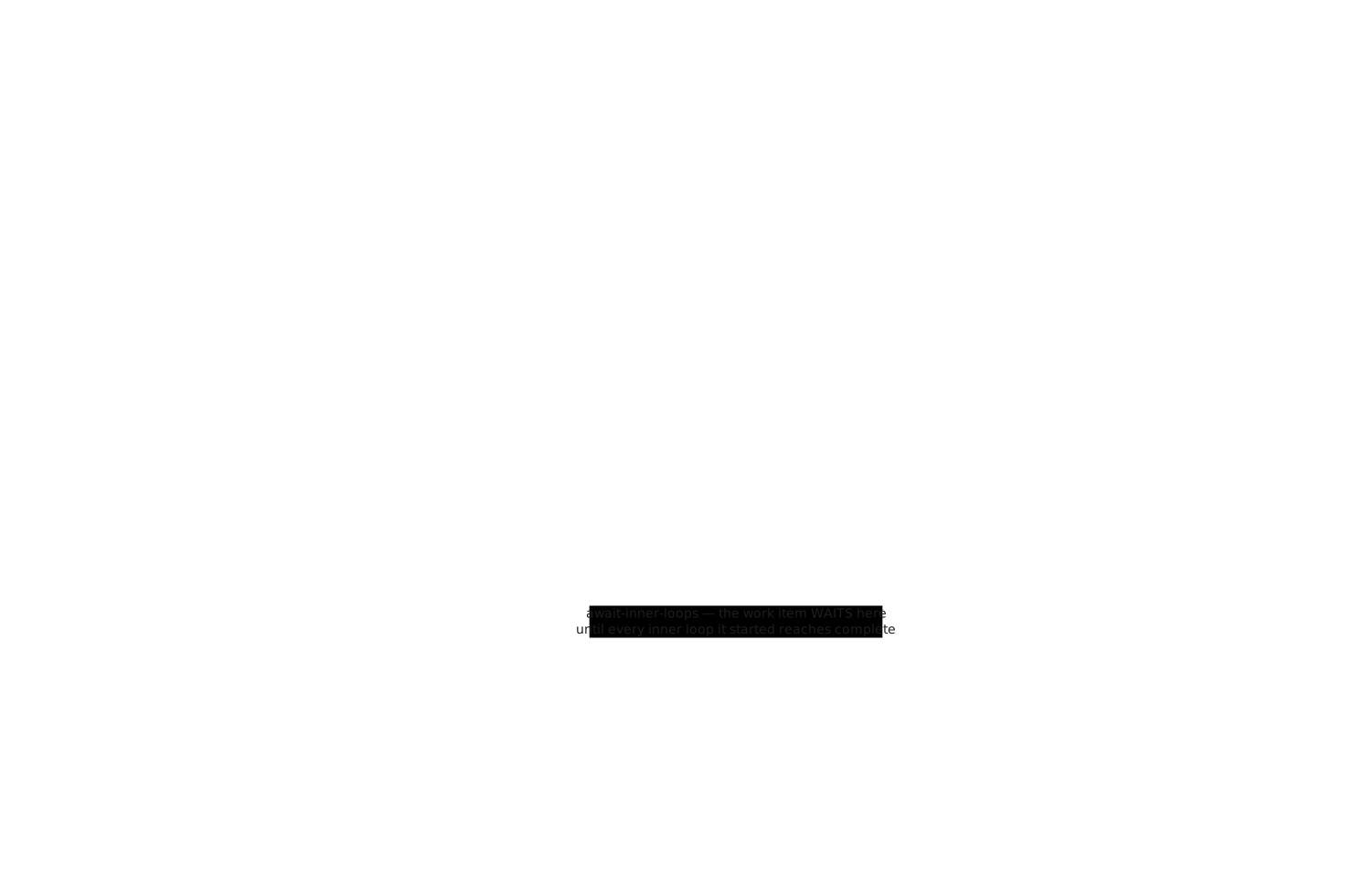
The same diagram the README carries — one drawing, one source. Drawn with Excalidraw; both the SVG (which embeds the scene) and the .excalidraw source under docs/assets/ re-open on excalidraw.com to edit.
A work item's position in the outer loop is tracked on the ticket by a loop:<phase> label, with the fine detail in its work-item-state.json:
not-started → brainstorming (optional) → requirements-definition → design
  → test-planning → tasks-breakdown → implementation → verification → needs-review
  → complete
Full detail: the process-graph capability.
The artifact chain
A work item is a chain of documents, each derived from the one before it. An artifact with a human approval gate is iterated with the feedback that gate records, and the gate locks it (status: approved, written with the approver on the human's one approval) — only then is the next one written and the phase advanced. Artifacts with no gate (the brainstorm, the task DAG) advance on shape alone, with no human stop. They live under docs/specs/<id>/, in the Kiro spirit:
| Artifact | What it settles |
|---|---|
brainstorm.md (optional) | A free-form scratchpad for a fuzzy idea: problem, options, open questions. A well-defined work item starts at requirements |
requirements.md (or bugfix.md for bugs) | User stories and EARS acceptance criteria, plus a threat-model-lite Security considerations section |
design.md | Architecture, components, data models, error handling, and a Security design section enforcing every boundary the requirements raised |
testing-plan.md | How the work item will be proved: which kinds of testing apply and which are n/a with a reason, the verification environment, the evidence to capture, and the activities checklist |
tasks.md | A DAG of small, verifiable tasks; each names the requirement it satisfies and the testing-plan row that proves it |
testing-plan.md is worth its own note. It is authored at the test-planning node — before the task DAG that references its rows — and reviewed together with the design, so it gets human review without a stop of its own. It is then completed at the verification node: the same file is written once as a plan and once as a record, so intent and outcome sit in one diff. Evidence is committed under docs/specs/<id>/evidence/; a link to a CI run that expires is not evidence. See the testing reference.
Rules the loop enforces
- Every work item has a ticket. Its spec chain is reviewed and approved per phase before execution.
- Collaborators are identified up-front; not every task needs every persona.
- Every human decision leaves a paper trail on the ticket or pull request.
- Self-checks run tests at logical checkpoints; progress is logged for visibility.
- Configured self-reviews and critic reviews run before escalating to a human, and a work item may opt in to one more: a critic reading the completed
design.mdbefore the testing plan and the task DAG are derived from it, so a structural finding costs an edit rather than a rewrite. Off unless it is ticked atphase-selection. - Testing is planned, then executed:
test-planningdecides which kinds of testing apply and recordsn/awith a reason for the rest;verificationruns the plan and ticks an activity only once it has actually run. - Security is gated, not bolted on: a threat-model-lite in the requirements, enforcing mechanisms in the design, and a security review that is its own node with its own gate — never something an agent can quietly declare unnecessary. (Since issue-179 an authorized human may select it away up front, on the record, along with any other phase; the one thing no one can skip is being asked.)
- The same tooling runs locally and in CI; logging is identical at dev-time and runtime.
- Integration tests document their scenario in Gherkin docstrings, queryable as a table via
the-loop scenarios. - APIs are contract-first: REST specs in OpenAPI, GraphQL SDL; docs are generated from the contracts, never hand-written.
- Capability docs are the organized view of specs: per-work-item specs are the historical record; living docs under
developer/capabilitiesare the single source of truth for each capability's current behaviour, updated in the same pull request as the work item. - The user-facing docs ship with the change too: the README, this site and the operating-model skill are updated in the same pull request as the change that made them wrong, recorded in
evidence/documentation.md's## Documentationsection — which thecapability-docsnode gates. - UI/UX design is a first-class artifact: for user-facing work the design phase tracks Figma links and/or self-contained HTML+CSS+JS prototypes, iterated with the designer on the rendered output until the designer signs off.
- All commits follow Conventional Commits.
- Pull requests are written for the reviewer: a condensed, prioritized summary, mermaid diagrams, and documented low-level decisions — and the loop educates the user on those decisions (mandatory, not optional).
Next: install the-loop or jump straight to the quickstart.